


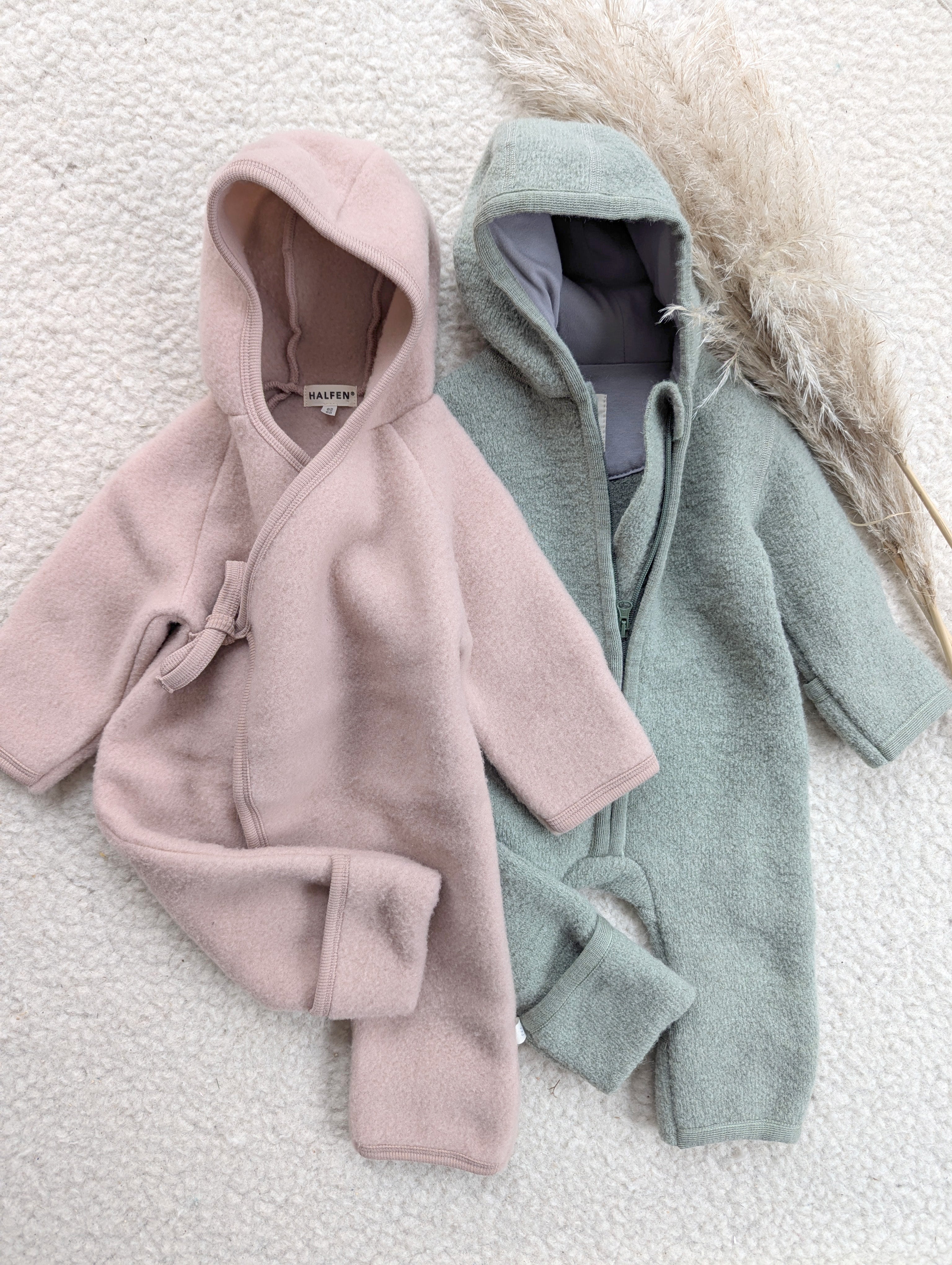
Boiled wool or wool fleece? If you're looking for natural clothing for your baby or child for cooler days, you'll quickly come across both materials. At first glance, they seem similar: both are made of wool, provide pleasant warmth, and are breathable. In everyday life, however, there are significant differences.
Boiled wool is denser, more robust, and better suited as an outer layer. Wool fleece, on the other hand, is particularly soft, light, and cuddly. Which option is right depends less on which material is fundamentally "better," but rather on when and how your child wears it.
Boiled wool and wool fleece: What's the difference?
The most important difference lies in the structure of the two fabrics.
Boiled wool is created by compacting a wool fabric with the help of moisture, heat, and movement. The wool fibers interlock, creating the typical compact boiled wool structure.
This makes the fabric robust, dimensionally stable, and comparatively wind-resistant. At the same time, the natural properties of the wool are preserved.
Wool fleece, however, has a softer and more open surface. A lot of air can be trapped between the fibers. This makes wool fleece particularly light, soft, and pleasantly warm.
Boiled wool: robust for little adventures
Boiled wool is an excellent choice, especially when your child is outdoors. Its dense structure makes it ideal as a natural outer layer for autumn, winter, and transitional periods.
The advantages of boiled wool
- warming and temperature-regulating
- breathable
- wind-resistant
- slightly water-repellent
- robust and durable
- ideal for active children
- well suited as a jacket, overall, trousers, or outer layer
Especially when children start walking, are on the playground, or discover nature, boiled wool shows its strengths. The material can withstand a lot and simultaneously protects against cool wind.
In short: Boiled wool is the right choice if you are looking for a natural, robust, and warm outer layer.
Wool fleece: soft, light, and cuddly
Wool fleece feels significantly fluffier and lighter. The soft structure makes it particularly comfortable for babies and children who are carried a lot or need a flexible warming layer.
The advantages of wool fleece
- particularly soft and cuddly
- very light
- pleasantly warm
- breathable
- temperature-regulating
- high freedom of movement
- ideal as an additional warming layer
Wool fleece is wonderfully suitable, for example, for the stroller, the baby carrier, for indoors, or for milder days outdoors. Under an additional weather layer, it can also be excellently worn as an insulating mid-layer.
In short: Wool fleece is ideal if you are looking for something particularly soft, light, and warm.
Boiled wool vs. wool fleece in direct comparison
| Property | Boiled Wool | Wool Fleece |
|---|---|---|
| Feel | dense & compact | soft & fluffy |
| Weight | slightly heavier | particularly light |
| Wind protection | higher | lower |
| Moisture | slightly water-repellent | less weather protection |
| Robustness | very high | slightly more sensitive |
| Outdoor | very well suited | for milder conditions |
| Mid-layer | conditionally | very well suited |
Which wool quality suits which weather?
Not all boiled wool is the same. How densely and heavily the fabric is worked is crucial, among other factors.
At HALFEN, we distinguish between different wool qualities so that you can choose the right option for your everyday life.
Firm boiled wool – approx. 650 g/m²
Our firm boiled wool is particularly dense and robust. It is excellently suited as an outer layer for cooler days and for children who spend a lot of time outdoors.
Due to its compact quality, it offers the highest protection among our boiled wool variants.
Fine boiled wool – approx. 400 g/m²
Fine boiled wool is lighter and more supple. It combines the typical properties of boiled wool with a particularly comfortable feel.
This makes it ideal for transitional seasons, milder days, and garments that require a lot of freedom of movement.
Wool fleece – approx. 300 g/m²
Wool fleece is our lightest of the three variants. It feels particularly soft and is especially suitable for milder days, indoors, or as an additional warming layer.
Important: Temperature indications can only be a guide. Every child perceives warmth differently, and wind, moisture, activity, and the clothing underneath also play a role.
Which is better for babies?
Especially for small babies, wool fleece is often a wonderful choice. The low weight and soft surface ensure that the clothing is not bulky and does not unnecessarily restrict movement.
Especially in a baby carrier or stroller, a light wool layer can be very comfortable.
If, on the other hand, the garment is primarily to be worn outdoors and offer a bit more wind protection, boiled wool might be the more suitable choice.
Which is better for toddlers?
The more active a child becomes, the more important the robustness of the clothing becomes.
For children who walk, play, sit, climb, and explore the world outdoors, boiled wool is often particularly practical. The compacted fabric withstands the demands of everyday family life better.
Wool fleece still remains a nice addition – for example, as a light jacket, sweater, or additional layer.
The onion principle: rather several well-thought-out layers
Instead of bundling children up as thickly as possible, the onion principle has proven its worth in everyday life.
For example:
- Base layer: a light layer directly on the body
- Warming layer: for example, merino or wool fleece
- Outer layer: for example, boiled wool
The great advantage: Depending on the weather and activity, a layer can simply be removed or added.
Is boiled wool waterproof?
No. Boiled wool is not waterproof.
The dense wool structure can repel light moisture and is therefore practical in changeable weather. However, in heavy or prolonged rain, boiled wool does not replace waterproof rainwear.
Due to its softer, more open structure, wool fleece offers even less weather protection and should be worn under a suitable outer layer in the rain.
How do I care for boiled wool and wool fleece?
One of the great advantages of wool: it does not need to be washed after every wear.
Caring for boiled wool
Often, airing out the garment thoroughly is enough. Light dirt can first dry and then be carefully brushed off.
Caring for wool fleece
Wool fleece should also be washed as rarely as necessary. Due to its fluffy structure, you should handle it with particular care.
If washing is necessary, the following applies to both materials: Always follow the care instructions for the respective garment.
Boiled wool or wool fleece – our decision-making aid
Still unsure? Then you can orient yourself by a simple question:
Choose boiled wool if…
- your child spends a lot of time outdoors,
- you are looking for a robust outer layer,
- wind protection is important,
- the garment should withstand as many adventures as possible.
Choose wool fleece if…
- you are looking for a particularly light wool quality,
- softness and cuddliness are a priority,
- you are looking for clothing for a baby carrier or stroller,
- you want a flexible warming layer for indoors and outdoors.
Our conclusion: Not better or worse – but suitable for everyday life
Boiled wool and wool fleece each have their own strengths.
Boiled wool convinces primarily with its robustness, density, and its properties as a natural outer layer.
Wool fleece scores with its light weight, its fluffy surface, and its particularly soft wearing comfort.
Which option suits you depends on your child, your daily life, and the intended use.
Because in the end, it's not about owning as much clothing as possible, but about finding the right favorite pieces – those that feel good and accompany you for a long time.
Less, but better.
At HALFEN, we think of clothing not just for one season. With durable materials, well-thought-out cuts, and timeless design, we want to create favorite pieces that accompany families through everyday life.
Our wool products are created with extensive experience and craftsmanship – in family tradition since 1928.
Share:
Walk Sleepsuit with Legs – why it offers more than a classic sleeping bag
Baby's First Winter Layette: Complete Checklist